
In data center development, the most expensive mistakes are not made during a loss.
They are made at the beginning of the project..
As demand for AI infrastructure accelerates across Texas, developers and contractors are moving quickly to build at scale. But in that speed, early decisions around insurance and risk structure are often made without full visibility into how they will perform later.
Coverage is placed. Contracts are signed. The project moves forward.
Everything appears in order.
But in large-scale infrastructure, early decisions do not stay isolated.
They compound.
And when something goes wrong, those early decisions determine how the outcome unfolds.
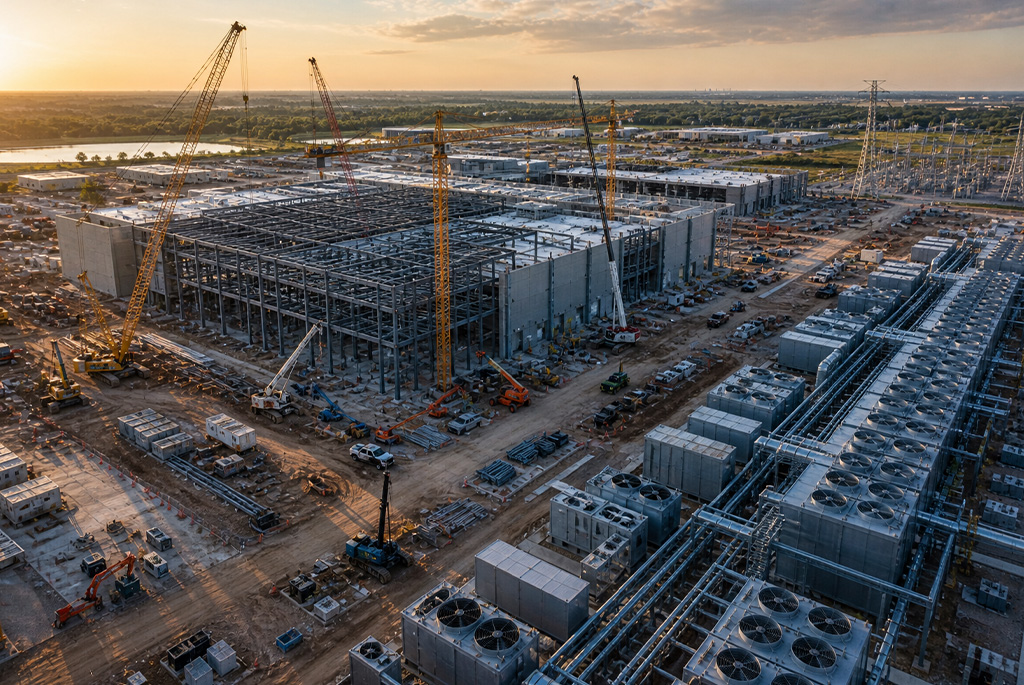
How a $20B Exposure Actually Develops
Consider a large-scale data center project.
The site is secured. Power agreements are in place. Construction begins with multiple parties involved across development, engineering, and execution.
Insurance is placed based on familiar structures. Builders risk, liability layers, and project requirements are put in place.
Contracts define responsibilities between stakeholders.
At this stage, everything appears aligned.
But beneath the surface, small gaps can begin to form.
A contractual obligation may extend beyond what the insurance program actually covers.
A retention may be higher than leadership fully understands across multiple policies.
A dependency on power or cooling infrastructure may not be reflected in how coverage responds.
Individually, each of these decisions may seem reasonable.
Together, they create a structure that has never been fully evaluated as a system.
When the Event Happens
Now introduce a realistic scenario.
A failure occurs within a critical system. It could be electrical, mechanical, or related to infrastructure integration.
The result is not just physical damage.
There is equipment loss, operational delay, and potential contractual exposure tied to performance expectations.
At that moment, the question is no longer what coverage exists.
The question becomes:
How does the program actually respond?
This is where the cascade begins.
How the Cascade Unfolds
The claim process starts.
But instead of a clear path to recovery, friction appears.
Coverage interpretation differs between carriers.
Contracts are reviewed and liability begins to shift between parties.
Gaps between policies become visible.
Retained financial exposure becomes larger than expected.
What initially looked like a contained event becomes a layered financial issue.
Not because insurance was missing.
But because the structure behind it was never fully aligned.
Why These Outcomes Are Predictable
These situations are not rare.
They are predictable in complex infrastructure projects where insurance has been assembled rather than intentionally designed.
Data center projects introduce a level of complexity that changes how risk behaves.
High value concentration, layered contracts, and operational dependencies create an environment where small misalignments become large exposures.
Without a system-level evaluation, those misalignments remain hidden.
Until they are tested.
Most insurance programs look strong until they are put under stress.
The Role of Early Decisions
Most of the financial outcome of a loss is determined before construction is complete.
It is shaped by how contracts are structured, how risk is transferred between parties, how retained exposure is defined, and how policies interact across the program.
These decisions are often made independently.
But they do not operate independently.
They function together, whether they have been evaluated that way or not.
What Strategic Insurance Design Changes
Strategic Insurance Design shifts the focus from placement to performance.
Instead of asking what policies are in place, it evaluates how the entire program functions as a coordinated system.
Insurance coverage, retained financial exposure, and contractual risk transfer are reviewed together.
This creates clarity around:
- how risk actually flows through the project
- where financial exposure sits
- how the program responds under stress
Insurance should not be evaluated by what is in place. It should be evaluated by how it performs under stress.
When this alignment exists, outcomes become more predictable.
When it does not, the program introduces uncertainty at the worst possible time.
A Different Way to Evaluate Risk
In data center development, scale amplifies everything.
Small gaps become large losses.
Minor misalignment becomes material exposure.
That is why the evaluation standard must change.
It is no longer enough to confirm that coverage is in place.
The question is whether the structure behind it has been designed to perform under real conditions.
What This Means for Developers and Contractors
If you are involved in large-scale infrastructure projects, the most important work happens before a loss occurs.
It is in how the program is structured.
It is in how contracts and coverage align.
It is in understanding how financial exposure is distributed across the project.
Because once the event happens, the structure is already set.
And the outcome follows it.
Where to Go Deeper
To better understand how this risk is evolving, start here:
For industry-specific insight:
The Real Cost of a $20B Mistake
The mistake is not a single decision.
It is the accumulation of decisions that were never evaluated together.
That is where financial exposure grows.
That is where recovery becomes uncertain.
And that is where projects that appear well protected begin to experience outcomes that leadership did not expect.
Evaluate Your Insurance Program
If your organization is involved in data center development, AI infrastructure, or complex construction projects, it may be time to step back and evaluate how your insurance program is structured.
The MB Davis Group provides independent commercial insurance consulting to help leadership understand how their program actually performs and where it can be strengthened.
“The most important question isn’t whether your company has insurance. It’s whether your insurance program will perform the way you expect when your business faces its most significant loss.”
— Mitchell B. Davis
Founder | Senior Consultant | Strategic Risk Advisor
Independent Commercial Insurance Consultant
About The MB Davis Group
The MB Davis Group is an independent commercial insurance consulting firm specializing in Strategic Insurance Design for businesses operating in complex, risk-driven industries. We help organizations evaluate how insurance coverage, contractual risk transfer, and retained financial exposure work together to support operational and financial stability.
Frequently Asked Questions
What causes financial exposure in data center projects?
Financial exposure is caused by misalignment between insurance coverage, contractual obligations, and retained risk. These gaps are often created early in the project and remain hidden until a loss occurs.
Why do early insurance decisions have long-term impact?
Early decisions define how risk is structured across the project. Once contracts are signed and coverage is placed, the financial outcome of a loss is largely predetermined.
How do small risk gaps turn into large losses?
In large-scale infrastructure, small gaps compound across contracts, policies, and dependencies. When an event occurs, these misalignments combine into significant financial exposure.
What breaks first when an insurance program is tested?
Alignment breaks first. Differences between policy intent, contract obligations, and actual coverage response create friction, delays, and unexpected retained loss.
How should insurance programs be evaluated for complex projects?
They should be evaluated as a system, not as individual policies. Coverage, retained exposure, and contractual risk transfer must be aligned to ensure the program performs under real conditions.
What is the real risk in data center development?
The real risk is not the event itself, but how the insurance program responds. Poor structure can turn a manageable issue into a major financial outcome.
What is Strategic Insurance Design in data center projects?
Strategic Insurance Design is an approach that evaluates insurance coverage, retained exposure, and contractual risk transfer as a unified system to ensure the program performs as expected under real conditions.
Read More - Commercial Insurance Strategies and Risk Management
 When Power Becomes the Risk—The Insurance Challenge Behind the Data Center Boom
When Power Becomes the Risk—The Insurance Challenge Behind the Data Center Boom
 5 Reasons Companies Are Turning to Strategic Insurance Design
5 Reasons Companies Are Turning to Strategic Insurance Design
 When Catastrophe Hits the Plant: The Insurance Question Most Companies Never Ask
When Catastrophe Hits the Plant: The Insurance Question Most Companies Never Ask
 The $20B Mistake: How Early Risk Decisions Cascade in Data Center Development
The $20B Mistake: How Early Risk Decisions Cascade in Data Center Development
 The AI Infrastructure Boom: Why Data Centers Are Reshaping Construction Risk