
Across Texas, a new type of construction is accelerating faster than anything the industry has seen before.
Data Centers.
Not small facilities, but multi-billion-dollar infrastructure projects built to support artificial intelligence, cloud computing, and global connectivity.
Developers, contractors, and investors are moving quickly to meet demand. But beneath that momentum is a quieter reality.
These projects are being built with a different level of risk, and most insurance programs have not been designed for it.
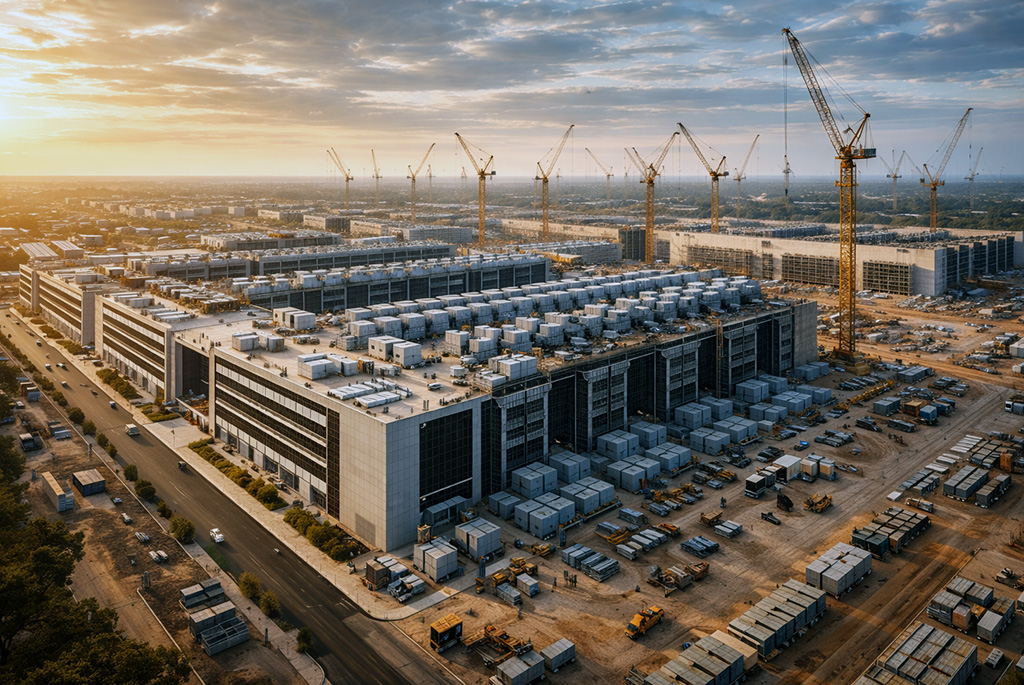
What’s Actually Happening in Texas
Texas has become one of the primary hubs for data center development in the United States.
- Billions of dollars are being deployed across Dallas, Austin, San Antonio, and emerging markets
- Individual projects now exceed $1B to $20B in construction value
- Power demand from data centers is expected to double or triple in key regions over the next decade
- Developers are competing for land, power access, and speed to deployment
This is not a typical construction cycle.
This is infrastructure being built at scale, under pressure, with long term consequences.
That changes how risk needs to be evaluated.
Why Traditional Insurance Thinking Doesn’t Hold Here
Most construction teams approach insurance the same way they always have.
Builders risk policies, general liability, excess layers, and project specific requirements are put in place.
On the surface, everything appears covered. But these projects introduce complexity that traditional approaches do not fully address.
The real question is not whether insurance exists.
The real question is:
Is your insurance program structured to perform under this level of exposure?
How Data Centers Reshape the Risk Profile of Construction
Data centers are not just larger buildings.
They are highly specialized environments where multiple risk factors come together.
Concentrated asset values
A single facility can contain hundreds of millions or billions of dollars in equipment and infrastructure.
Loss is no longer distributed. It is concentrated.
High electrical density and technical complexity
These facilities rely on:
- Advanced cooling systems
- Redundant power infrastructure
- High load electrical environments
Small issues can escalate quickly.
Multi layered contractual risk
Every project involves multiple parties including developers, EPC contractors, subcontractors, equipment suppliers, and power providers.
Contracts determine how risk flows. If contracts and insurance are not aligned, liability can move in ways leadership does not expect.
Construction and operational risk overlap
Risk does not stop when the building is complete.
Construction defects, equipment failure, uptime requirements, and service interruption exposures overlap and compound.
Speed to market
These projects are moving fast.
Insurance decisions are often made under pressure, without a full evaluation of how the program is structured. As a result, gaps are created that are not visible upfront.
Where Insurance Programs Lose Alignment
Most insurance programs are not designed. They evolve.
Policies are added over time. Projects expand. Contracts change. Without a full evaluation, programs can become fragmented across carriers, misaligned with contractual obligations, and unclear in terms of retained financial exposure.
This is especially common in data center construction.
The issue is not visible until there is a claim.
As your framework states, most programs evolve rather than being intentionally designed, which leads to misalignment with real exposure.
Designing Insurance for Complex Infrastructure
This is where Strategic Insurance Design becomes essential.
Instead of reviewing policies individually, the program is evaluated as a system.
Three elements must work together:
- Insurance coverage
- Retained financial exposure
- Contractual risk transfer
Insurance should not be evaluated by what is in place. It should be evaluated by how it performs under stress.
When these elements are aligned, the program performs as expected. When they are not, gaps appear when it matters most.
Strategic Insurance Design focuses on how these elements function together across the business.
What This Means for Decision Makers
If you are involved in data center or AI infrastructure projects, this is not just about having coverage in place.
It is about whether the program has been designed for this level of complexity.
Insurance directly affects project financing, lender approvals, contract negotiations, capital exposure, and claim outcomes.
A poorly structured program can shift liability back to your organization, create gaps between policies, and increase retained loss.
A well structured program protects both the project and the balance sheet.
Where to Go Deeper
If you are active in these projects, these areas are worth reviewing:
- Digital infrastructure and Data Center Insurance Strategy
- Construction and General Contractor Industry Insurance Strategy
These outline how insurance impacts both infrastructure operations and construction performance. They reinforce a consistent reality.
Insurance decisions made early in a project shape long-term financial outcomes.
The One Question Leadership Should Be Asking
Before moving forward on a major project, ask:
What does our worst-case loss actually look like, and will our program respond the way we expect?
Most organizations have not answered this clearly.
In data center construction, that answer matters.
A Shift in How Risk Must Be Understood
This is not just a construction boom.
It is a shift in how infrastructure is built and how risk is carried.
In high value infrastructure, the question is not whether risk exists. It is whether the structure behind it has been designed to absorb it.
Organizations that approach insurance with structure and intent will protect capital, reduce volatility, position claims for recovery, and operate with clarity. Others will discover the gaps later.
Evaluate Your Insurance Program
If your organization is involved in data center development, AI infrastructure, or complex construction projects, it may be time to step back and evaluate how your insurance program is structured.
The MB Davis Group provides independent commercial insurance consulting to help leadership understand how their program actually performs and where it can be strengthened.
“The most important question isn’t whether your company has insurance. It’s whether your insurance program will perform the way you expect when your business faces its most significant loss.”
— Mitchell B. Davis
Founder | Senior Consultant | Strategic Risk Advisor
Independent Commercial Insurance Consultant
About The MB Davis Group
The MB Davis Group is an independent commercial insurance consulting firm specializing in Strategic Insurance Design for businesses operating in complex, risk-driven industries. We help organizations evaluate how insurance coverage, contractual risk transfer, and retained financial exposure work together to support operational and financial stability.
Frequently Asked Questions
What makes data center construction risk different?
Data center construction involves concentrated asset values, high electrical loads, and complex systems, where a single failure can cause significant financial loss.
Why do traditional insurance programs fall short?
Most programs evolve over time and are not designed for complex infrastructure, leading to gaps between coverage, contracts, and actual risk exposure.
What is strategic insurance design?
Strategic insurance design aligns coverage, retained risk, and contractual risk transfer to ensure the program performs under real-world loss scenarios.
How do contracts impact risk in data center projects?
Contracts determine how risk is transferred between parties. If not aligned with insurance, liability can shift unexpectedly and increase exposure.
What are the biggest insurance risks in data center construction?
Key risks include concentrated asset values, equipment failure, power interruptions, construction defects, and misaligned insurance coverage.
How should organizations evaluate their insurance program?
Organizations should assess worst-case loss scenarios, coverage limits, exclusions, and how policies align with contractual obligations.
Read More - Commercial Insurance Strategies and Risk Management
 When Power Becomes the Risk—The Insurance Challenge Behind the Data Center Boom
When Power Becomes the Risk—The Insurance Challenge Behind the Data Center Boom
 5 Reasons Companies Are Turning to Strategic Insurance Design
5 Reasons Companies Are Turning to Strategic Insurance Design
 When Catastrophe Hits the Plant: The Insurance Question Most Companies Never Ask
When Catastrophe Hits the Plant: The Insurance Question Most Companies Never Ask
 The $20B Mistake: How Early Risk Decisions Cascade in Data Center Development
The $20B Mistake: How Early Risk Decisions Cascade in Data Center Development
 The AI Infrastructure Boom: Why Data Centers Are Reshaping Construction Risk